 |

The BeOS Virtual Tour
Under the Hood
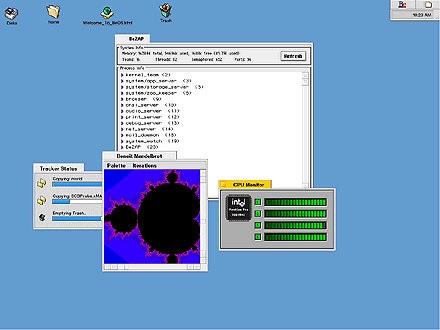
What makes the BeOS so fast and efficient? For starters, the BeOS cast off
the chains of "legacy code", freeing it from the restrictions of ancient
computing methods.
In their place was put an architecture specifically designed for handling
intensive tasks, such as digital audio and video. The building blocks
include:
- Symmetric multiprocessing
Take advantage of two, four or more processors in a single machine.
- Pervasive multithreading
Multithreading takes large tasks, such as applications, and breaks them
down into a myriad of smaller tasks. Pervasive multithreading means that
this approach is used throughout the BeOS, from the kernel, through the
graphics and I/O systems, and through BeOS applications.
- Preemptive multitasking
The BeOS works on and rapidly switches between dozens, often hundreds, of
smaller tasks. These tasks can be deployed on a single processor, providing
a smooth multitasking environment, or across any number of processors in a
multiprocessor system.
- 64-bit journaling file system
This enables extremely large volumes and files, of terabyte size and more,
enough to handle even raw uncompressed, high-resolution video and audio --
the foundation for high-quality editing systems. The Be file system goes
even further, providing database capabilities allowing the storage of
multiple attributes and indexes along with files.
- Object-oriented APIs
The BeOS API makes programming easy and efficient.
For more information, check out the BeOS Product Data Sheet or the Media OS Whitepaper.
Okay, lets see what all that power does for you.
Tour Index |Previous |
Next
BeOS Release 4
Copyright © 1998 Be, Inc.
|